Executive Summary
The following report examines the phenomenon of organized online hatred directed at survivors and victims of the Nova Music Festival massacre, which took place on October 7th, 2023. In the months and years that followed, FOA documented a sustained and multi-layered digital campaign aimed at erasing, distorting, and justifying the events of that day — targeting not only the memory of the massacre but the survivors themselves.
The findings presented here are based on content collected and reviewed by FOA analysts across major social media platforms, including X (formerly Twitter), Instagram, TikTok, Reddit, and Telegram, between October 2023 and April 2026. Content was selected to represent the dominant narrative categories identified during the monitoring period. All screenshots have been preserved as evidentiary records.
The phenomenon of online hatred toward Nova Festival survivors is a broad, multi-layered digital campaign aimed at erasing, distorting, or justifying the events of the October 7th massacre. The following is a summary of the key findings regarding the scope of the phenomenon and the dominant platforms:
- Organized networks operating at scale: Academic research has identified networks comprising thousands of coordinated fake accounts used to spread disinformation targeting Israeli users and online discourse. Some of these networks are linked to state actors, primarily Iran, operating to deepen social divisions and spread narratives of insecurity.
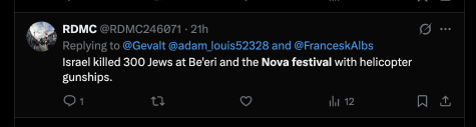
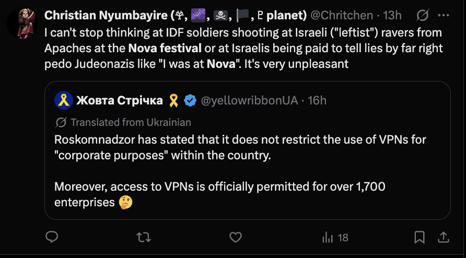
- Denial and distortion narratives: The phenomenon ranges from complete denial – claiming the massacre was a staged event involving “crisis actors” and fake blood, to posts and comments that shift blame onto the IDF (through a manipulated framing of the “Hannibal Directive” or the “Apache myth”).
A tweet describing Nova survivors as paid liars and implying that an IDF Apache helicopter was responsible for the casualties, a direct illustration of the "Apache myth" narrative referened in this section.
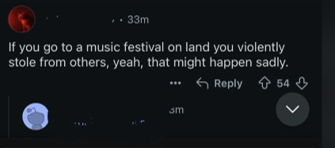
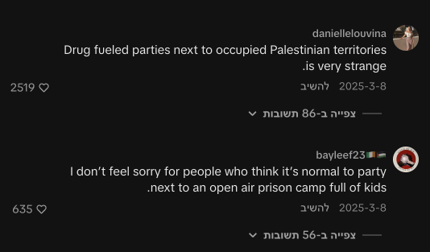
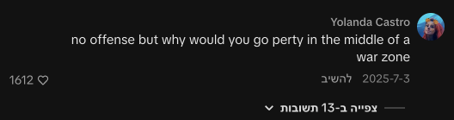
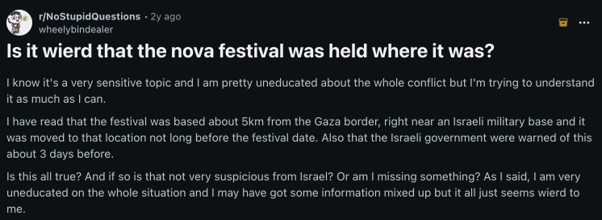
- Victim blaming: A widespread narrative questions the legitimacy of holding a festival near Gaza, framing the event as a “geographic provocation” or a religious desecration (due to the party being held on the Sabbath and a Jewish holiday), leading to the conclusion that the victims “brought it upon themselves.”
- Denial of sexual violence: There is a systematic trend of mockery and denial of survivor testimonies regarding sexual violence.
Two Reddit comments: one questioning the occurrence of rape on the grounds that no video evidence exists, and another describing the assaults as a "friendly gesture of respect" — explicit examples of the systematic mockery and denial of survivor testimonies.
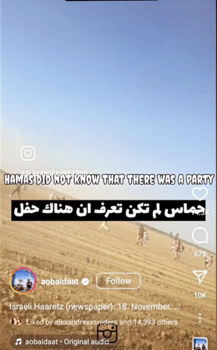
- Low removal rates: Despite reports filed, platforms demonstrate inadequate enforcement.
An Instagram reel in Arabic claiming that "Hamas didn't know there was a party" and attributing casualties to an Israeli helicopter.
The content remained active on the platform despite violating terms of service, illustrating the failure of platform enforcement.
Dominant Platforms
- Instagram: Serves as a primary arena for influence operations targeting younger audiences.
- X (formerly Twitter): The platform has become a hub for “false flag” claims and viral conspiracy theories.
- Telegram: Functions as a distribution center for raw, unfiltered, and unverified content, including Hamas propaganda and graphic videos used to distort reality. Due to the absence of monitoring, it serves as a “first stop” for narratives that subsequently spread across the rest of the internet.
- TikTok: A platform saturated with harassment of survivors, antisemitic memes, and videos that exploit popular trends to spread hate messages or mock the suffering of civilians.
- UpScrolled: A new application that emerged as an alternative for those who felt their voices were being silenced on major platforms. It quickly became a refuge for extreme content, Holocaust denial, and explicit calls for violence against Jews, with no community moderation.
Conclusions and Recommendations
The narrative playbook is consistent. Across platforms and languages, the same core strategies appear repeatedly: denying the massacre occurred, redirecting blame onto the IDF, framing victims as aggressors, and silencing survivors through personal harassment. This consistency suggests coordinated effort rather than organic discourse.
Platforms are failing to enforce their own policies. Content that explicitly violates terms of service, including calls for violence, denial of sexual assault, and targeted harassment of named individuals — routinely remains active after being reported. Low removal rates reflect a policy failure.
Survivors are being harmed twice. The harassment documented here is not abstract. Named individuals, including hostages and their families, are subjected to sustained campaigns of abuse that compound the trauma of October 7th itself.
Based on these findings, FOA calls for the following:
- Social media platforms must implement faster and more consistent enforcement mechanisms for content targeting survivors of mass atrocities.
- Governments and regulatory bodies should hold platforms accountable for failure to remove content that constitutes incitement or targeted harassment.
- Further research is needed to map the full scope of state-linked networks: particularly those connected to Iran, that are actively amplifying these narratives.
Additional Documentation
The following section presents additional documented examples of online hate content targeting Nova Festival survivors and victims, collected across multiple platforms between 2023 and 2026. Each item illustrates one or more of the narrative patterns identified in this report.
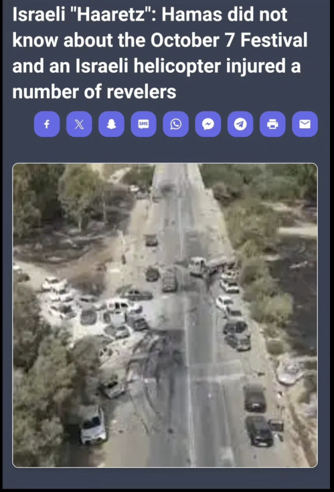
An Instagram post presenting a manipulative headline attributed to Haaretz, claiming "Hamas didn't know about the festival and an Israeli helicopter injured revelers" — accompanied by a drone image of burned vehicles on the escape road.
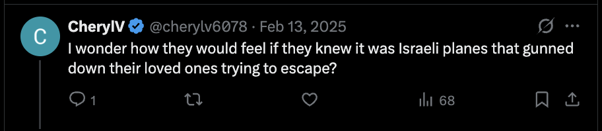
A tweet suggesting that bereaved families should know it was Israeli planes that "gunned down their loved ones trying to escape" - a continuation of the blame-shifting narrative.
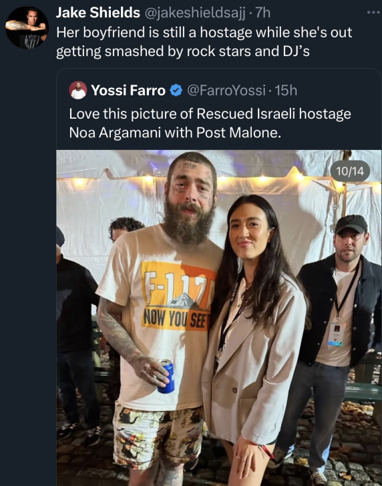
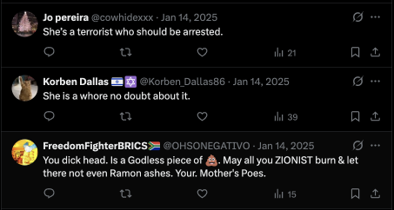
A tweet referencing a photo of Nova survivor Noa Argamani with Post Malone after her release, followed by replies containing sexual slurs, accusations of terrorism, and calls for violence — illustrating targeted personal harassment of a named survivor.
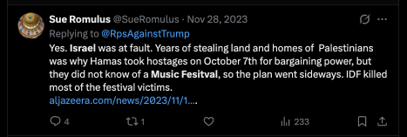
A tweet from November 2023 claiming the IDF killed most festival victims while Hamas was attempting to take hostages - an example of systematically shifting responsibility from Hamas to Israel.
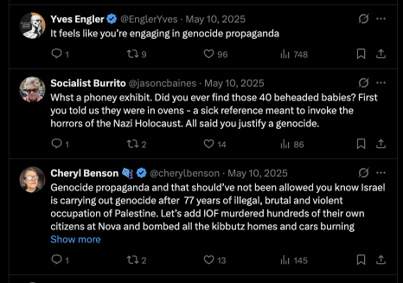
A thread of replies to a Nova exhibition post containing Holocaust distortion, denial of beheaded babies, and accusations of Israeli genocide — demonstrating the pattern of hate that surrounds any attempt to document or commemorate the massacre.
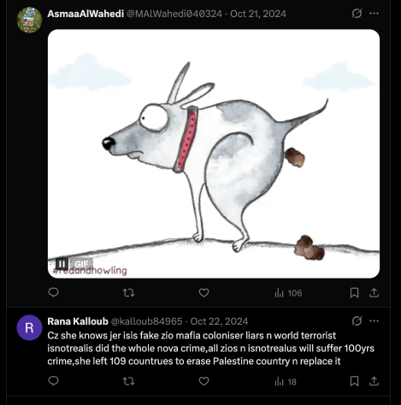
A tweet containing a crude antisemitic attack targeting a survivor by name, labeling her a "Zionist" and a "mafia member".
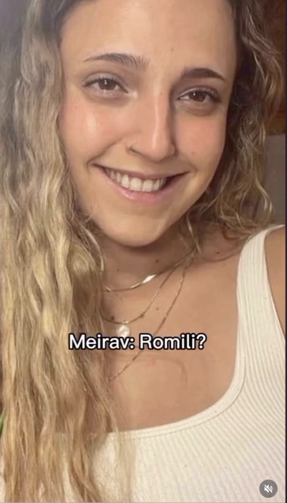
A video of Romi Gonen and her mom Meirav phone call on Oct. 7 accompanied by a comment reading "bring her home in a box,”

A Reddit reply blaming the victims for attending an event on "stolen land"
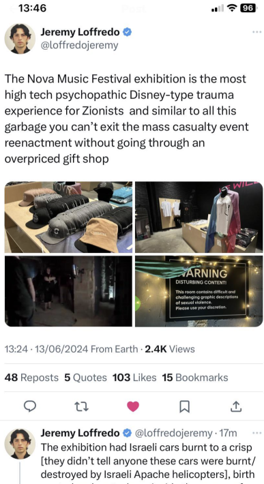
A viral tweet cynically describing the Nova exhibition as a "high-tech psychopathic Disney-type trauma experience for Zionists" — illustrating how even commemorative efforts become targets for organized online hatred.