Summary
This report examines how a provision in the U.S. National Defense Authorization Act (NDAA) to expand U.S.-Israel defense technology cooperation was distorted into a viral conspiracy theory claiming that Israel—and ultimately Jews—are taking control of the U.S. military. Section 219 of the bill establishes a Pentagon mechanism to coordinate joint defense technology development and procurement, which critics falsely portrayed as a “merger” of the two militaries.
As the claim spread from politicians to influencers, to conspiracy theorists all via social media, particularly X, it evolved from allegations about foreign influence into explicit antisemitic narratives accusing Jews of secretly controlling the U.S. government through AIPAC, Mossad, blackmail, and other familiar tropes. The report shows how a routine policy proposal was transformed through a chain of distortions—from cooperation between the US and Israeli militaries, to integration, to merger, to Jewish control.
While questioning whether such close cooperation is in the American interest – all reasonable arguments point that it is – recasting defense cooperation as evidence of a Jewish takeover revives classic antisemitic conspiracy theories. Once again we see social media, and specifically X, as the medium through which fringe controversy morphed to hate, with the social media companies, especially X, making little to no effort to monitor hate content on their platform.
Recommendations
- Rapid-response monitoring and fact-checking to identify and counter false narratives before they become widely established in real time by NGOs (like FOA) specially focused on identifying hate trends – in very close coordination with social media companies.
- Improve detection of coded antisemitic conspiracy narratives by ensuring platforms address not only explicit hate speech but also disguised forms of antisemitic misinformation and conspiracy theories.
The evolution of a conspiracy theory: a bill in Congress
On July 22, the US House of Representatives passed H.R.8800 – National Defense Authorization Act for Fiscal Year 2027, a $1.15 trillion defense funding bill. The bill passed by 216 votes to 212, and is now on its way to the Senate. It is a huge bill, with hundreds of sections – on everything from military use of AI to pay levels of servicemen. A small part of the bill relates to various regions – Europe, the Indo-Pacific, the Middle East, etc. The Israel part is relatively short, consisting of several sections, one of which, Section 219, deals with US-Israel technology cooperation.
Section 219 would set up a function within the Pentagon to coordinate and accelerate bilateral defence-technology cooperation, identifying jointly developed or Israeli-origin technologies that could have operational value for American systems. It would move useful research into procurement, create licensing and joint-venture frameworks and encourage co-production inside the United States.. The technologies listed for consideration include missile and air defence, counter-drone systems, anti-tunnelling technology, artificial intelligence, advanced sensors, directed energy, cyber defence, electronic warfare, medical defence and contested logistics. These are precisely areas in which Israel has developed substantial expertise and accumulated extensive real-world experience while confronting rockets, drones, ballistic missiles, terrorism and cyberattacks.
How the conspiracy began
The current narrative entered mainstream political debate through Republican Congressman Thomas Massie. Massie first described Section 219 in comparatively technical terms, warning about the “integration” of American military technology and supply chains with Israel.
After the House vote, however, his language escalated: he claimed that the NDAA “tragically merges our military technology and supply chains with Israel’s” and called the provision a betrayal of American sovereignty. Former Representative Marjorie Taylor Greene amplified the allegation, describing the proposal as a merger of the two militaries and even as “treason.” Representative Lauren Boebert similarly claimed that Pentagon officials could use Section 219 to “give away America’s secrets,” despite the provision’s explicit requirements to protect sensitive technology, classified information and the national-security interests of both countries.
Once prominent political figures had legitimized the word “merge,” the allegation spread through large online influence networks. Tucker Carlson accused Congress of preparing to merge the American military with Israel’s armed forces, while other major accounts framed the issue through terms such as “Israel First,” “AIPAC-controlled,” “foreign occupation,” “Mossad blackmail” and “the Epstein class.”
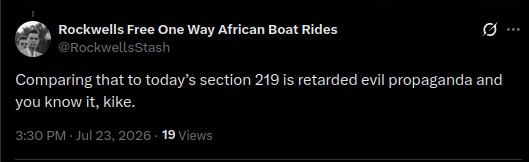
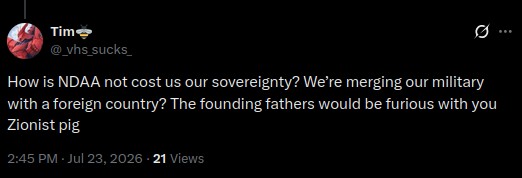
As the story moved further down the online information chain, it became increasingly explicit and antisemitic. Smaller accounts portrayed Section 219 as evidence that America was a “Zionist Occupied Government,” a “United States of Israel” or the victim of a “Zionist coup” and “treason.” Congress was described as controlled by AIPAC, while politicians were portrayed as puppets manipulated through Mossad or Epstein-related blackmail. Other posts invoked “Rothschilds,” a “Khazarian mafia,” “Jewish supremacy,” “Jewish masters,” dual loyalty and demands that supposed “traitors” be punished. ZOG, or “Zionist Occupied Government,” is itself a longstanding white-supremacist conspiracy theory alleging that Jews secretly control the American government.
The main antisemitic tropes
The conspiracy theory combines several established antisemitic narratives:
- Secret control and puppet governance: Israel – and ultimately Jews – are portrayed as secretly controlling Congress, the Pentagon and the U.S. government.
- ZOG: The United States is recast as a “Zionist Occupied Government,” “Zionist coup” or “United States of Israel.”
- Dual loyalty and treason: Jewish Americans and lawmakers supporting the bill are accused of serving “Jewish masters” rather than the United States.
- Hidden cabals: References to Mossad, AIPAC, the Rothschilds and the “Epstein class” invoke the classic antisemitic conspiracy of a secret Jewish network manipulating political events.
What Section 219 actually says
The text of the bill does not call for merging the U.S. and Israeli militaries. Instead, Section 219 would establish a Pentagon function to coordinate and accelerate bilateral defense-technology cooperation, identifying jointly developed or Israeli-origin technologies that could benefit American military systems. It would facilitate research, licensing, joint ventures and co-production in the United States.
The technologies under consideration include missile and air defense, counter-drone systems, anti-tunneling technology, artificial intelligence, advanced sensors, directed energy, cyber defense and electronic warfare—areas in which Israel has developed significant expertise and operational experience. The proposal builds on an established history of U.S.-Israeli cooperation, including the Arrow, David’s Sling and Iron Dome missile-defense programs, which have provided technical data, testing experience, interoperability and access to technologies relevant to American defense systems.
Section 219 therefore seeks to expand technology exchange while potentially bringing more resulting production into the United States. In practical terms, Israel contributes technological innovation and operational knowledge while the United States can provide resources, scale and manufacturing capacity. The broader security relationship also includes counterterrorism and intelligence cooperation concerning Iran, terrorist organizations, cyber threats and regional security. Some of this cooperation remains classified, making its full impact impossible to quantify, but documented cases demonstrate that intelligence sharing has contributed to the protection of American citizens, military personnel and aviation.
From Cooperation to “Occupation”
The conspiracy theory can be reduced to a simple chain of substitutions:

At each stage, important distinctions disappear. A proposal concerning research, licensing, procurement and defense technology becomes alleged evidence that Israel has taken control of the Pentagon. From there, the argument expands into the claim that Jews collectively control Congress, the military and the American government.
The “Epstein class” provides a particularly effective bridge between these narratives. While the term can refer generally to wealthy or protected elites, when combined with references to Ghislaine Maxwell, Mossad, Zionist blackmail, AIPAC “puppets” and Jewish control of politicians, it becomes another vehicle for the claim that a hidden Jewish network controls the state.
Criticism of Israel, AIPAC, military assistance or Section 219 is not inherently antisemitic. The line is crossed when policy criticism is replaced by claims that Jews collectively buy, blackmail or secretly command the government; that Jewish Americans are inherently disloyal; or that a hidden Jewish network is taking control of the armed forces.
Section 219 can and should be subjected to factual scrutiny and legitimate debate over whether closer U.S.-Israeli defense cooperation serves American interests. But portraying it as evidence of Israeli occupation—or of Jewish control of America—transforms a policy dispute into one of the oldest antisemitic conspiracy theories: the claim that Jews are the invisible rulers behind political and military power.
Reported and Removed Content
This chart illustrates the content removal rates (in percentages) for items identified and reported by the FOA. Data was gathered exclusively from X and Facebook to analyze overall removal trends.
Inconsistencies in Social Media Content Moderation
We often find no clear explanation for why certain content is removed while other similar material remains online, revealing notable inconsistency in social media Trust & Safety moderation. Standard reporting mechanisms frequently fail to take down content containing extreme hate speech or direct threats. In these cases, removal typically occurs only after we contact the social media platforms directly to escalate the issue.